
Key Takeaways
- Street dogs look the same in India, Africa, Southeast Asia and Latin America because a life lived on human scraps favors one practical body type.
- Free-breeding village dogs are the world’s normal dog: researchers estimate they make up about three out of every four dogs on Earth.
- DNA shows street dogs in different regions have very different family histories, yet they still end up looking strikingly alike.
- A street dog’s life is hard: in one Indian study, only about 1 in 5 puppies survived long enough to breed.
- The US and Britain have few street dogs because of rabies control, licensing and stray dog control, not because they have fewer dogs.
The Dog You’ve Seen Everywhere
Most people assume street dogs look the same by pure chance, just a random mix of breeds.
That couldn’t be further from the truth.
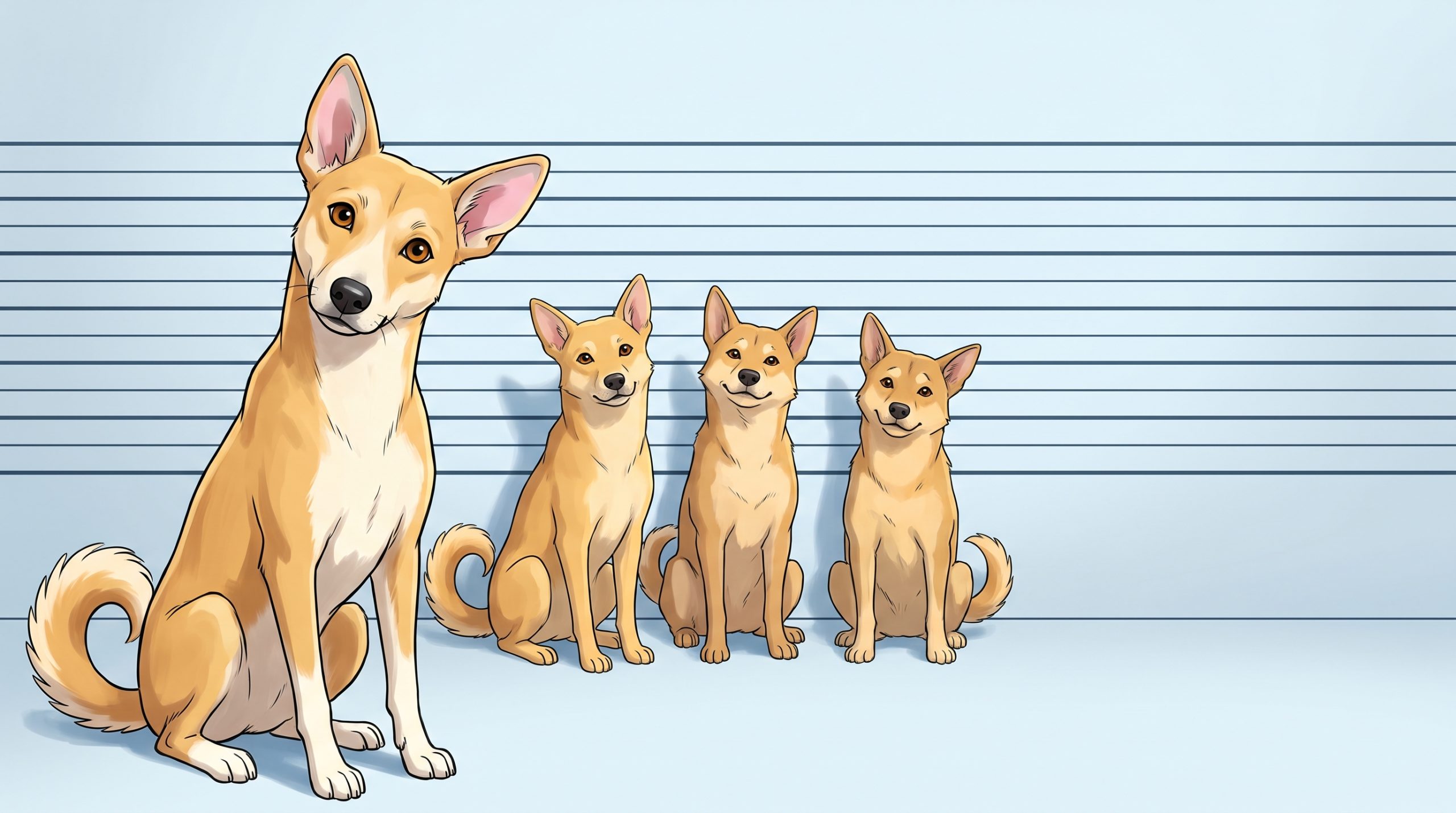
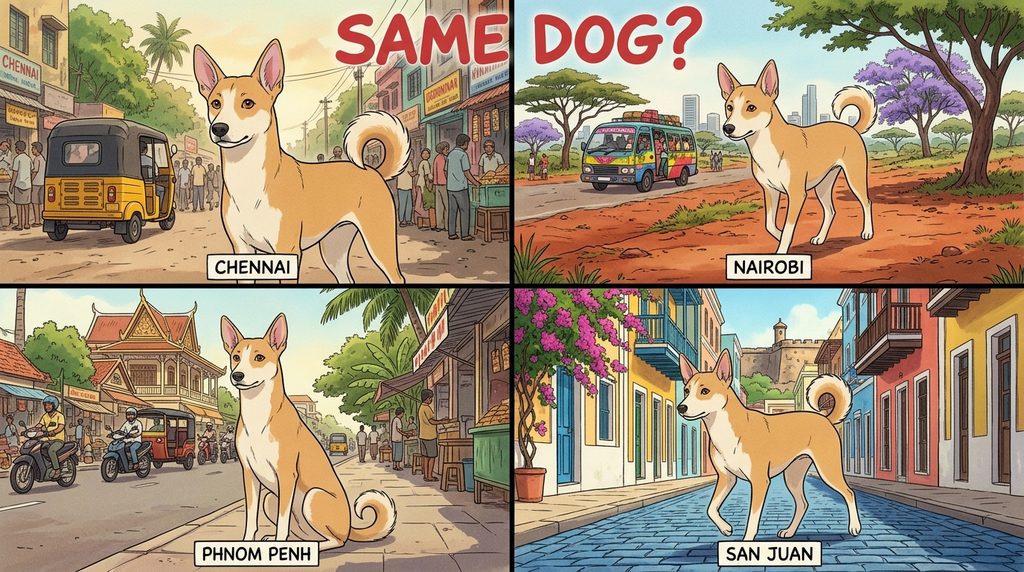
Look closely and you’ll see the same dog again and again. Medium size. Sandy coat. Pointed nose. Ears standing straight up. A tail that curls over its back.
You’ll find it at a gate in Chennai, on a road in Nairobi, in a doorway in Phnom Penh and on a beach in San Juan.
Nobody breeds these dogs. Nobody decides who mates with whom. Yet street dogs thousands of miles apart keep ending up looking like the same animal.
And if you grew up in the United States or Britain, you’ve probably never seen one loose on your own street. That’s no accident either.
This guide explains why street dogs look the same almost everywhere, using real research on village dogs, DNA and public health.
I’ll walk you through the leading theory behind their shape, what genetic studies revealed, the mystery of the Carolina dog, and why some countries have almost no street dogs at all.
1. What Street Dogs Look Like (and Why They Aren’t Clones)
Before going further, one thing needs to be clear: these dogs aren’t clones.
Street dogs vary from place to place. They tend to be bigger in colder regions and smaller on tropical islands. Coat colors range from sandy tan to reddish brown, black-and-tan and cream, and some dogs have white patches or a floppy ear.
But the same general pattern shows up again and again. Researchers describe village dogs as medium-sized dogs with pointed snouts, and many have upright ears and a tail that curls over the back. Most weigh somewhere between 20 and 50 pounds (about 9 to 23 kilograms).
So, not identical. But similar enough that a traveler can spot “the same dog” on different continents.
2. Three Out of Four Dogs on Earth Live This Way
It’s easy to think of street dogs as the exception and pet dogs as the norm. The numbers say the opposite.
Biologists Raymond and Lorna Coppinger estimated that about three out of every four dogs on Earth are free-breeding dogs like these. They find their own food. They choose their own mates. No breeder plans their puppies, and no kennel club records their family tree.
In other words, the Labrador sleeping on your couch is the unusual one. The dog at the gate in Chennai is much closer to what a typical dog looks like around the world.
3. Why This Shape? The Coppinger Theory
The best-known explanation comes from Raymond Coppinger, a biologist who spent decades studying free-ranging dogs around the world.
His idea is simple: these dogs weren’t designed. They fit a job, and that job is living on what people throw away.
Think about what that job demands. A bigger body needs more food, and scraps don’t arrive in large amounts. A very small body has its own problems: it can be pushed aside by other dogs and can’t travel far to find food. So the middle wins. A medium-sized, lean dog can live on leftovers and still hold its own.
Coppinger once repeated a line from a Navajo shepherd describing the ideal sheepdog: “Not too big and not too small.” He thought it described village dogs perfectly.
It’s a clever theory, but not everyone accepts all of it. Other scientists argue that the scavenger story can’t explain the whole history of dogs, and the idea that village dogs are the “original” dogs has little support. So it’s best to treat it as a strong idea, not a closed case.
4. What the DNA Revealed
Here’s where the story gets stranger.
A large genetic survey led by researchers at Cornell University tested village dogs from 38 countries. In places like India, Vietnam and Egypt, the dogs carried almost no European breed ancestry. They appear to be old local lines that have lived alongside people in those regions for a very long time.
But in Latin America and the South Pacific, the results were very different. Village dogs there turned out to be almost completely descended from European dogs, dogs that arrived with European colonists.
That gives two very different family histories. And yet in both places, people describe the same kind of dog.
This suggests the shape doesn’t come from ancestry alone. When dogs live freely, with nobody choosing which ones breed, they seem to drift toward the same body type again and again.
5. The Carolina Dog Mystery
To see this pattern in a single place, travel to a swamp in South Carolina.
In the 1970s, a biologist named Larry Brisbin was working at the Savannah River Site, about 300 square miles of forest and wetland that had been closed to the public since 1950 because the US government was producing nuclear material there.
While studying wildlife, he kept running into dogs. They were ginger-colored, with pointed snouts, ears that stood up and tails that curled back over the body.
At first, Brisbin assumed they were ordinary strays. But over time he began to suspect something else: a population that had been living on its own, near people, for a very long time. He later helped get them recognized as a breed, now known as the Carolina dog.
Scientists still debate where Carolina dogs came from. And they do something no one has fully explained: females dig small pits in the dirt, just big enough for their snouts, mostly in fall and winter. Why they do it is still an open question.
Look at the shape again: medium size, pointed face, upright ears, curled tail. It’s the same kind of dog, living at the edge of human life and finding its own way.
6. The Hard Life of a Street Dog
None of this means a street dog’s life is easy.
In a five-year study in West Bengal, India, researchers followed 95 litters, a total of 364 puppies. Only about 19% lived long enough to breed. Roughly 63% of the deaths were influenced by people, directly or indirectly, including cases of poisoning.
So the shape you see on the street isn’t the shape of an easy life. It’s the shape of one that survives.
7. Why the US and Britain Have No Street Dogs
Now back to the question from the beginning: why don’t you see these dogs roaming in the United States or Britain?
It isn’t because Americans or Britons have fewer dogs. It’s because both countries built systems around them.
In the US, public health officials brought dog rabies under control through vaccination, dog licensing and stray dog control. In 2007, the Centers for Disease Control and Prevention (CDC) declared the canine rabies variant eliminated from the country.
Britain went further, and earlier. It got rid of dog rabies in the early 1900s, using strict muzzling and dog control rules.
In both countries, fewer free-roaming dogs was a side effect of one goal: protecting people from a deadly disease.
8. Rabies Today: Why the Numbers Matter
Those rules were built around a real danger. The World Health Organization (WHO) estimates that rabies kills about 59,000 people a year worldwide. Nearly all of these cases come from dog bites, and about 40% of the victims are children under 15.
Even the numbers are debated. The WHO has estimated roughly 18,000 to 20,000 rabies deaths a year in India, while a national survey in 2022 and 2023 put the figure closer to 5,700. Either way, it’s a serious public health problem.
So the honest answer isn’t “leave street dogs alone,” and it isn’t “get rid of them.” Both approaches miss what actually drives the number of dogs on the street, and what actually keeps people safe.
Safety note: If you’re ever bitten or scratched by a dog where rabies is present, wash the wound with soap and running water for at least 15 minutes and see a doctor as soon as possible. Rabies is almost always fatal once symptoms appear, but treatment given promptly after a bite is highly effective.
9. Why Fewer Scraps Means Fewer Street Dogs
The Coppingers argued that the number of free-living dogs follows the food supply. Where there’s plenty of open garbage, such as food scraps at markets, uncovered dumps and leftovers on the street, there’s enough to feed many free-breeding dogs. Where open garbage disappears, the number of dogs tends to fall with it.
In other words: less open garbage, fewer free-breeding dogs.
This also explains why simply removing dogs often doesn’t last. If the food is still there, new dogs move in to use it. Change the food supply, and the population changes too.
Vaccination is the other half of the picture. Vaccinating dogs against rabies protects the dogs themselves and the people who live alongside them. Together, cleaner streets and widespread vaccination address both sides of the problem: how many dogs there are, and how safe they are to live with.
10. The “Shepherd Mix” at Your Local Shelter
Here’s one last picture.
Imagine you walk into an animal shelter and see a card that says “shepherd mix” on a medium-sized dog with a pointed face and upright ears. Then you look at the tail. It curls up over its back.
You might be looking at the shape dogs keep arriving at whenever nobody is designing them. It’s the same dog from the gate in Chennai, the road in Nairobi, the doorway in Phnom Penh and the swamp in South Carolina. It wasn’t made by a breeder. It was made by a life lived close to people.
Frequently Asked Questions
Are street dogs a breed?
Mostly, no. Most street dogs are free-breeding village dogs. Nobody plans their matings, and no kennel club registers them. A few local populations have been given breed names, such as the Carolina dog in the United States and the Indian pariah dog (often called the INDog or desi dog) in India. Most street dogs around the world, though, are better described as a natural type of dog than a formal breed.
Why do so many street dogs have curled tails and upright ears?
Researchers have noted that many village dogs share these traits, along with a medium build and a pointed snout. The leading theory, from Raymond Coppinger, is that this general body type suits a life of living on human scraps. Scientists still debate the details, and no single explanation has been proven.
Are street dogs dangerous?
Most street dogs avoid conflict with people. The main health risk is rabies in countries where it is still present. Avoid approaching or touching unfamiliar dogs, especially mothers with puppies or dogs that are eating. If you’re bitten or scratched, wash the wound with soap and running water for at least 15 minutes and see a doctor quickly.
What are street dogs called in different countries?
Many places have their own name: “potcake” in the Bahamas and parts of the Caribbean, “askal” in the Philippines, “sato” in Puerto Rico, and “desi dog” or “Indian pariah dog” in India. What are they called where you live? Let us know in the comments on the video.
Sources
- Coppinger, R. & Coppinger, L. (2016). What Is a Dog? University of Chicago Press. (Free-breeding village dogs, the “not too big, not too small” idea, and the estimate that about three out of four dogs are free-breeding.)
- Shannon, L. M., et al. (2015). Genetic structure in village dogs reveals a Central Asian domestication origin. Proceedings of the National Academy of Sciences, 112(44).
- Brisbin, I. L. Jr. & Risch, T. S. (1997). Primitive dogs, their ecology and behavior. Journal of the American Veterinary Medical Association, 210.
- Smithsonian Magazine. Tracking America’s First Dogs.
- Paul, M., et al. (2016). High early life mortality in free-ranging dogs is largely influenced by humans. Scientific Reports, 6, 19641.
- Centers for Disease Control and Prevention (2007). US Declared Canine-Rabies Free.
- Thangaraj, J. W. V., et al. (2025). Estimates of the burden of human rabies deaths and animal bites in India, 2022–23. The Lancet Infectious Diseases, 25(1).
Recommended Reading
Street dogs from India to the Caribbean share one look. Nobody bred them, so why do they match? The science, the DNA, and the Carolina dog mystery.

