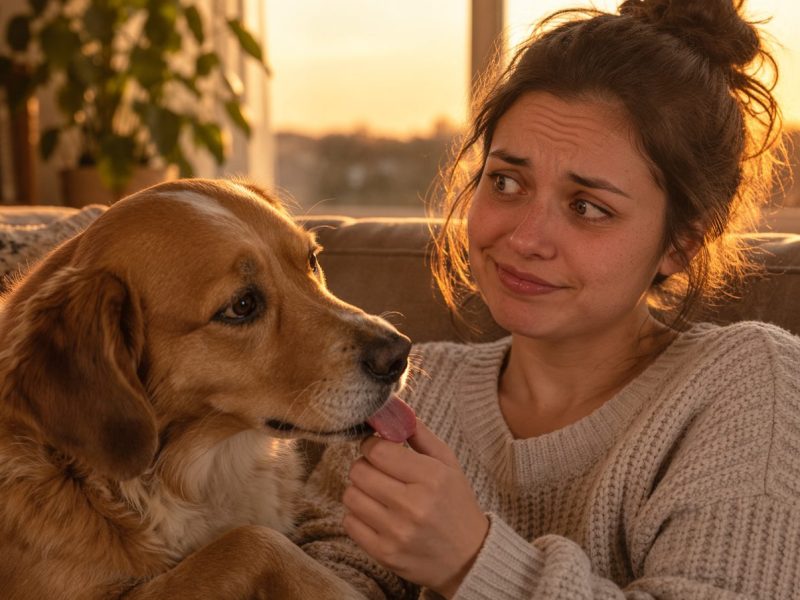
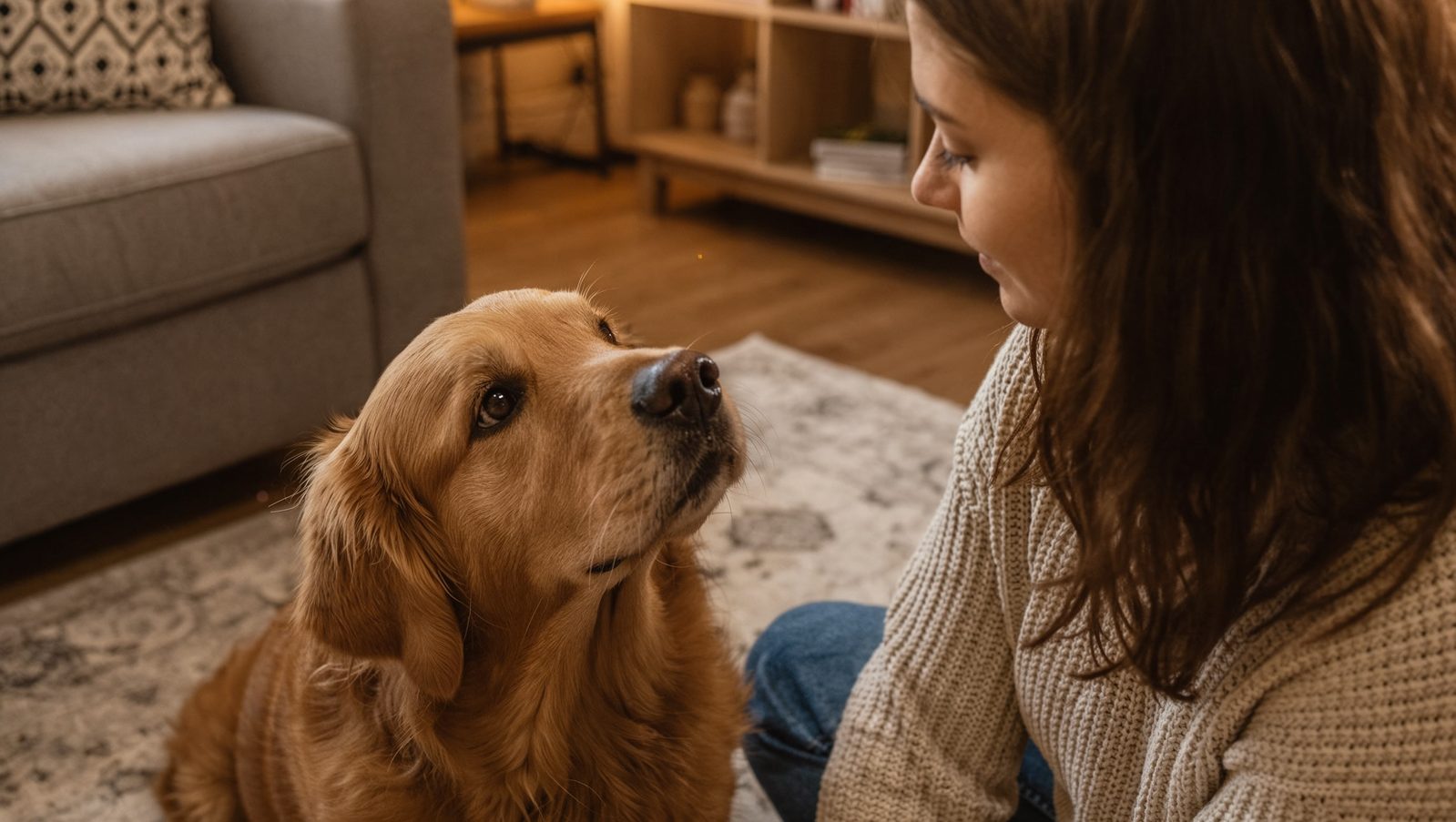
You look up from your phone, and there it is: your dog, sitting a few feet away, eyes locked on you. Not barking. Not moving. Just watching. Most of the time it feels sweet. But now and then a long stare feels a little unsettling, and you can’t help asking: why does my dog stare at me like that?
The answer depends on the moment. Most stares are friendly, curious or hopeful. One kind is a warning, and it helps to know the difference.
▶ Watch the video below to see each type of stare, and the body language that goes with it.
Quick answer: Dogs stare at their people to connect, to ask for something, to wait for a cue or to read your mood. Soft eyes and a relaxed body usually mean affection or interest. A stare with a stiff, frozen body, hard eyes and a closed mouth is different. It can mean your dog feels threatened or is guarding something, and you should give space.
Why Eye Contact Matters So Much to Dogs
Dogs read faces closely, and they’ve had thousands of years of living alongside people to get good at it. When your dog looks at you, it’s gathering information. Where are you going? Are you happy? Is that a treat in your hand?
Eye contact can also be a bonding moment. Research from Japan found that when dogs and their owners gazed at each other, levels of oxytocin, a hormone linked to bonding, rose in both. That doesn’t mean every look is a love letter. But it does suggest that soft, mutual gazing is good for both of you.
The key is the word soft. The same eyes can send very different messages depending on the rest of the body.
7 Reasons Your Dog Stares at You
1. Your Dog Feels Close to You
A relaxed dog who gazes at you from the couch, blinks slowly and maybe thumps its tail is usually just enjoying your company. This kind of stare tends to happen in calm moments, after a walk, during an evening at home, or while you’re both resting.
You’ll often see loose ears, a soft face and a slightly open mouth. It’s the canine version of a comfortable silence.
2. Your Dog Wants Something
Many stares are simple requests. Dinner time is close. The leash is by the door. You’re eating something that smells amazing.
Dogs learn quickly that looking at you works. If staring has ever been followed by food, a walk or play, your dog will try it again. The “stare at me while I eat” moment is a classic example.
3. Your Dog Is Waiting for Direction
Dogs pay close attention to what their people are about to do. A dog who watches you as you put on shoes, pick up keys or walk toward the kitchen is often waiting to find out what happens next.
Well-trained dogs also look at their owners for cues. That eye contact is a sign that your dog is tuned in and ready to listen.
4. Your Dog Is Reading Your Mood
Dogs are skilled at picking up our emotions from our faces, voices and posture. If you’re upset, tense or unusually quiet, your dog may watch you more closely, trying to work out what changed.
This is part of why many owners feel their dog “just knows” when something is wrong.
5. Your Dog Is Curious or Confused
A stare paired with a head tilt often means your dog is trying to make sense of something: a new sound, a word it half-recognizes, or a strange thing you’re doing. It’s interest, not worry.
6. Your Dog Feels Uneasy
Not every stare is relaxed. A dog who feels stressed may watch you closely while showing other small signals:
- A tense or still body
- Lip licking when no food is around
- Yawning when it isn’t tired
- Pinned-back ears
This often happens in new places, around unfamiliar people or after a change in routine. Your dog is looking to you for information, and maybe for reassurance.
7. Your Dog Is Scared
A frightened dog may stare with wide eyes, big pupils and the whites of its eyes showing (sometimes called “whale eye”). The body is usually lowered, the tail tucked and the weight shifted back.
This dog is trying to keep track of something it finds threatening. It needs space and calm, not closeness or correction.
The Warning Sign: The Hard Stare
This is the stare every owner should recognize. A hard stare looks very different from a soft gaze:
- The body goes stiff and still, sometimes completely frozen
- The eyes are fixed and unblinking
- The mouth is closed and tight
- The weight may lean forward
- It may come with a low growl or lifted lip
A hard stare often shows up when a dog is guarding something it values, like food, a chew, a toy or a favorite resting spot. It can also mean the dog feels threatened and is warning you not to come closer.
What to do: stop, stay calm and slowly move away. Don’t stare back, reach for the item or scold. A warning is useful information, and punishing it can teach a dog to skip the warning next time. If you see this stare more than once, especially around food or toys, get help from a professional (see below).
Read the Whole Dog, Not Just the Eyes
The eyes are only part of the message. Look at the rest of the body to understand what a stare means:
- Tail: a loose, wide wag usually signals friendliness. A high, stiff tail that moves in small, fast flicks can mean tension or arousal, not happiness. A tucked tail points to fear.
- Ears: relaxed or softly to the side is calm. Ears pricked forward show alertness. Ears pinned flat back often mean fear or worry.
- Hackles: raised fur along the back means your dog is aroused. That might be excitement, fear or defensiveness, so check the rest of the body.
- Mouth: a soft, open mouth is relaxed. A tight, closed mouth or lifted lip signals stress or a warning.
- Posture: loose and wiggly is good. Stiff, frozen, or low and crouched means something is off.
When you put these clues together, a stare stops being a mystery.
How to Respond to Your Dog’s Stare
- Return a soft gaze. If your dog is relaxed, a gentle look, a slow blink or a quiet word can be a lovely bonding moment.
- Don’t reward every request stare. If your dog stares at your plate, calmly ask for a “settle” on a mat and reward that instead.
- Respect their space. If the stare comes with signs of stress or fear, give your dog room to move away and avoid forcing contact.
- Build confidence with gentle socialization. Introduce new people, places and sounds slowly, and pair them with good things like treats and play.
- Create a safe spot. A quiet bed or crate where your dog can rest undisturbed helps a nervous dog recharge.
- Never punish a warning. Growling and hard stares are communication. Change the situation instead.
Signs to Watch For
- ✅ Normal: soft eyes, relaxed face and a loose body while looking at you
- ✅ Normal: staring at you around meals, walks or playtime
- ✅ Normal: watching you closely when you’re getting ready to leave
- ⚠️ Watch: staring with lip licking, yawning or a tense body
- ⚠️ Watch: wide eyes, whale eye, a tucked tail or a crouched body
- ⚠️ Watch: a stiff, frozen stare over food, toys or a resting spot
- ⚠️ Watch: a hard stare with growling, a lifted lip or forward-leaning body
- ⚠️ Watch: a sudden change in how often or how intensely your dog stares
Frequently Asked Questions
What does it mean when a dog stares at you?
It depends on the body language. A soft stare with a relaxed body usually means affection, curiosity or a request, like “Is it dinner time?” A stiff, frozen stare with a tight mouth can be a warning to give space.
Why does my dog stare at me while I eat?
Most often, your dog hopes to share. If staring has ever earned a bite, your dog has learned that it works. Teach a calm alternative, like lying on a mat, and reward that instead.
Is it bad to stare back at my dog?
With your own relaxed dog, a soft, friendly gaze is fine and can even feel bonding. Avoid staring hard at an unfamiliar, nervous or guarding dog, since a direct stare can feel threatening to them.
Why does my dog stare at me without blinking?
A long, soft look in a calm moment is usually attention or affection. An unblinking stare with a frozen body, especially near food or toys, is different and can be a warning. Look at the whole dog to tell which one you’re seeing.
Can staring mean my dog loves me?
Often, yes. Calm mutual gazing has been linked to bonding hormones in both dogs and people. Just remember that a loving stare looks soft and relaxed, never stiff.
The Stare Is Your Dog Talking
Your dog can’t tell you what it’s thinking, but its eyes come close. Most of the time, that steady gaze means “I’m with you,” “What’s next?” or “Is that for me?”
Once you know what a hard stare looks like, you’ll also know when to step back and give space. That simple awareness makes life safer and calmer for both of you, and it makes the soft, loving looks even easier to enjoy.
▶ See every type of stare side by side, including the warning stare most owners miss, in the full video below.

Petsheed helps dog owners understand what their dogs are communicating. Each article and video is researched from published studies and veterinary and behavior sources, listed at the end of every post.