
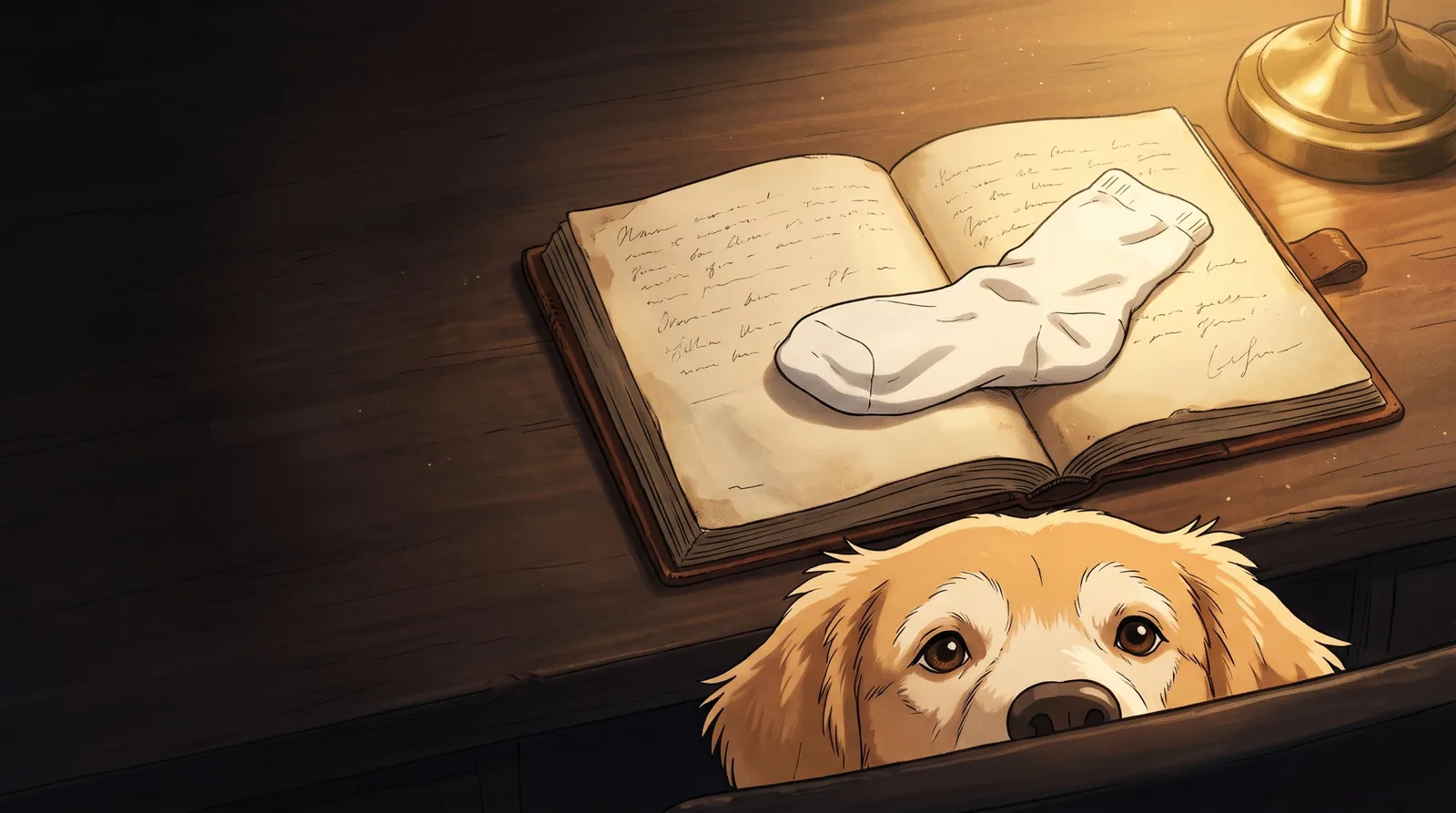
You open the front door, and there he is. His tail is swinging, and a single sock dangles from his mouth like a trophy. If you share your home with a golden, you’ve probably wondered why golden retrievers bring you things. And why can’t he walk past a puddle without stepping right in? These habits aren’t random. They go back more than 150 years, to a cold corner of Scotland and a man who kept careful notes about his dogs.
▶ Want to see the story come to life? Watch the video below.
Quick answer: Golden retrievers were bred in the Scottish Highlands to find birds that had been shot and carry them back gently, often through cold water. That’s why so many goldens love to carry things to their people and why they’re drawn to puddles and ponds. When your golden brings you a sock, he may be inviting you to play, greeting you, asking for attention, or simply enjoying something that smells like you.
It Started With One Man and His Notebook
The golden retriever’s story begins with Dudley Marjoribanks, a Scottish politician who later became Lord Tweedmouth. He had a large estate in the Highlands, and he loved bird hunting. He also had an unusual habit for his time: he wrote down records of every dog he owned, year after year.
His hunting grounds were beautiful but hard to work in. Cold lakes, fast rivers and thick, soaking-wet heather covered the land. When a bird came down in one of those places, a hunter often couldn’t reach it on foot.
So Marjoribanks needed a very specific kind of dog. It had to find the fallen bird, get to it through water or rough ground, and bring it back without damaging it.
The Dogs Behind the Breed: Nous and Belle
Marjoribanks looked for three key traits:
- A strong nose to find the bird
- A gentle mouth to carry it without crushing it
- A love of water to reach birds that landed in lakes and rivers
In the mid-1860s, he bought a yellow puppy called Nous. Then, in 1868, he paired Nous with Belle, a Tweed Water Spaniel. That breed was a river dog from the Scottish Borders, and it has since died out. The yellow puppies from that pairing became the foundation of the golden retriever we know today.
Notice what mattered most to him. He wasn’t trying to create a pretty dog. He was building a dog for a job. Those working skills still show up in your golden today.
Why Do Golden Retrievers Love Water?
A golden’s love of puddles makes a lot of sense once you look at his coat. Goldens have a double coat, meaning two layers of fur:
- The outer coat is thick and water-resistant, so water tends to run off.
- The undercoat is soft and dense, and it holds in body heat.
That combination was made for cold Highland water. Imagine an early morning on a misty lake. A bird is floating out of reach, and a golden-colored dog swims out calmly to bring it back.
So when your dog splashes into a pond or flops down in a muddy puddle, he isn’t misbehaving. He’s using the body his ancestors were bred to have.
The downside of that warm coat
The same coat that keeps a golden comfortable in cold water can make hot days hard on him. In warm weather, a slow walk in the shade is usually kinder than a long, intense game of fetch.
Not every golden is a swimmer
Some goldens are unsure about water, and that’s perfectly normal. If your dog is nervous, let him wade in slowly and choose his own pace, with you close by. Never push or pull a dog into water. That can turn a little hesitation into real fear.
Why Do Golden Retrievers Bring You Things?
Hunting is a chain of steps: finding, chasing, catching and carrying. Over time, different hunting dog breeds were developed to be especially strong at different steps. Retrievers were shaped for the final one, which is picking something up and carrying it back to a person in one piece.
Breeders call this gentle grip a soft mouth. It’s still part of the golden retriever breed standard today.
Research supports the idea that this behavior runs deep. Large studies of dog behavior, involving thousands of dogs, have found that retrieving is one of the behaviors most strongly linked to genetics. When your golden trots over with your shoe, he’s showing a skill that was carefully selected for generations.
What the sock might mean
The urge to carry may be built in, but the message behind it can change from moment to moment. A sock delivery might mean:
- “Play with me!” It’s an invitation to a game.
- “You’re home!” Many goldens greet their people by grabbing something to carry.
- “Look at me.” If bringing you things has earned attention in the past, your dog may have learned to do it on purpose.
- “This smells like you.” Some dogs simply find comfort in holding something with your scent on it.
How to read your golden’s body
Your dog’s body language tells you which message you’re getting.
A loose, wiggly dog who prances around or bounces away with the sock is usually asking for play.
A stiff dog who freezes over the item, stares hard or goes very still is telling you something different: “Please don’t take this.” That’s called resource guarding. If you see it often, it’s worth getting help early from a qualified trainer.
Why Does My Golden Retriever Follow Me Everywhere?
Retrievers were never meant to work alone. They worked side by side with a hunter, watching for direction and staying close. Being near their person was part of the job.
That history is one reason so many goldens shadow their owners from room to room. Breed standards still describe the golden as friendly, trustworthy and eager to please. For many owners, that “velcro dog” quality is one of the breed’s sweetest traits.
Breed Is a Tendency, Not a Promise
It’s easy to think a golden “should” act a certain way, but every dog is an individual. A large 2022 study published in the journal Science found that breed explains only about 9% of the differences in behavior between individual dogs.
In other words, breed nudges behavior. It doesn’t decide it. If your golden has no interest in carrying anything, nothing is wrong with him. And if your mixed-breed dog delivers every sock in the house to your feet, that’s normal too.
Golden Retriever Puppies and Mouthing
If you’ve brought home a golden puppy, you’ve likely met the mouth. Fingers, sleeves, shoelaces and anything else within reach get the gentle chew treatment.
Mouthing is normal puppy behavior, and in a breed made for carrying, it can feel extra intense. The goal isn’t to shut that mouth down. It’s to redirect it toward things your puppy is allowed to have. For step-by-step help, see our guide on how to stop your puppy from biting.
A dog with a strong instinct and nothing to do with it will find his own outlet. Too often, that outlet is a couch cushion.
5 Ways to Live Happily With a Retriever’s Instincts
Your golden is carrying around a job description that’s more than 150 years old. These simple habits help that instinct fit into modern family life.
- Give his mouth a job. Keep a basket of dog-safe toys near the front door. When he feels the urge to grab something as you walk in, the easiest thing to reach is something he’s allowed to have.
- Trade, don’t chase. Running after a dog who has your sock teaches him it’s a fun game. Calmly offer a treat or a favorite toy instead, and swap.
- Keep small items off the floor. Socks, hair ties and small toys can be swallowed and may cause a dangerous blockage in your dog’s gut. If you think your dog swallowed one, call your vet right away.
- Play games that use his natural skills. Fetch, “find it” scent games and letting him carry a toy on walks all give the retrieving instinct a healthy outlet. A dog with a busy mind is usually a calmer dog at home. For more ideas, try these simple ways to keep your dog busy indoors.
- Be water smart. Always supervise swimming. Avoid ponds or lakes with green scum on the surface, which can be a sign of harmful algae. Let him build confidence at his own speed.
Signs to Watch For
Most retrieving and carrying is happy, healthy behavior. Here’s how to tell normal from worth-a-closer-look:
- ✅ Normal: a loose, wiggly body while carrying things around
- ✅ Normal: bringing you items when you come home or want to play
- ✅ Normal: splashing into puddles or happily wading into water
- ⚠️ Watch: stiffening, freezing, staring or growling over an item
- ⚠️ Watch: swallowing (not just carrying) socks, fabric or small objects
- ⚠️ Watch: sudden fear of water in a dog who used to enjoy it
- ⚠️ Watch: heavy panting, weakness or wobbliness after exercise on a hot day
When to Talk to a Vet or Trainer
Call your vet right away if you think your dog has swallowed a sock or another object. Also call if he’s vomiting, straining to poop, refusing food or seems to have a sore belly. Contact your vet too if his behavior changes suddenly, for example if a happy carrier suddenly stops wanting to use his mouth. Pain or illness is sometimes the cause.
Reach out to a certified positive-reinforcement trainer or a veterinary behaviorist if your golden often guards objects with a stiff body, a hard stare or growling, or if mouthing seems to be getting worse instead of better with time. Early, gentle help usually works best.
FAQ
Why does my golden retriever bring me socks?
Goldens were bred to carry things gently to their people, and socks are soft, easy to grab and smell like you. Depending on the moment, a sock can be an invitation to play, a greeting or a way to get your attention.
Why do golden retrievers love water so much?
They were developed to retrieve birds from cold Scottish lakes and rivers. Their water-resistant double coat is made for swimming. Still, some goldens are cautious around water, and that’s completely normal.
Where did golden retrievers originate?
Golden retrievers come from the Scottish Highlands. The breed began in 1868, when Dudley Marjoribanks (later Lord Tweedmouth) bred a yellow retriever named Nous with a Tweed Water Spaniel named Belle.
Why does my golden retriever follow me everywhere?
Retrievers were bred to work closely alongside a hunter, so staying near their person was part of the job. That history is one reason many goldens like to stay close to you around the house.
Is it bad if my dog swallowed a sock?
It can be serious. A swallowed sock can block your dog’s digestive system. Call your vet as soon as possible, even if your dog seems fine for now.
A Plan Written Long Before Your Dog Was Born
Lord Tweedmouth never set out to name a famous breed. He simply recorded his dogs, season after season, and his records are still preserved by the Kennel Club in London. The name “golden retriever” came later, given by other people.
But the blueprint was already there in his notes: a sharp nose, a gentle mouth and a heart that doesn’t mind cold water. More than a century and a half later, that same blueprint trots into your living room with a sock in its mouth. It isn’t mischief. It’s history, and in its own way, it’s affection.
▶ See Nous, Belle and the Highland lakes brought to life, and watch how a hunter’s notebook led to your golden’s favorite habit.
Sources
- Friends of Guisachan: The Guisachan dogs
- Golden Retriever Club of America: Origin of the yellow retriever
- Project Upland: Water spaniels, origins and development
- Project Upland: The curly-coated retriever
- Science (2022): Breed and behavior in dogs (Morrill et al.)
- Golden Retriever Club of America: Health research
- Morris Animal Foundation: Golden Retriever Lifetime Study
- PLOS ONE (2022): Cohort profile of the Golden Retriever Lifetime Study
- PubMed (2015): The Golden Retriever Lifetime Study, establishing an observational cohort study
Recommended Reading
Why Street Dogs Look the Same Everywhere (The Science Explained)